Monthly Archives: April 2012

Liquid Poetry at Chaddsford Winery

My friends and I meandered over to Chadds Ford, PA for a little fun and a wine tasting. Seeing as I’m going completely local in just over a month, I need to start nailing down where I’m going to get the necessities, like wine.

I don’t take myself too seriously, but there’s always something very serious about wine. Tasting wine is an event, an experience. It even comes with its own vocabulary. My friends and I decided words like complexity, oaky, tannic, nose, and balanced acidity are invaluable at a wine tasting. We used them a lot.

When I saw this sign stating, “Wine is bottled poetry,” I giggled. I’m not sure why. I guess that statement just seems so serious. Wine is at times, the best thing ever. I get it. But bottled poetry? Prove it to me, Chaddsford Winery.

I believe this is a quote by Robert Louis Stevenson

For $10, you can taste six wines and take home a snazzy commemorative glass. For free, you can taste all of the sweet wines. We decided to do both. Dry wines first, in the bottling room of the winery.

This is where poetry is bottled

In order to get to the bottling room, you walk downstairs to the basement (excuse me, that’s the cellar, not the basement) and through the rows of large stainless steel wine tanks and oak wine barrels. The stainless steel is a striking contrast to the wood barrels and the Pennsylvania stone of the cellar.

Stainless Steel Wine Tank. Made me want a giant glass.

Oak wine arrel

We each chose six wines to taste. My very sophisticated husband checked off the most expensive wines on the list. “Gotta get your money’s worth,” he said. (Sorry, ladies, he’s all mine.)

Let the tasting begin!

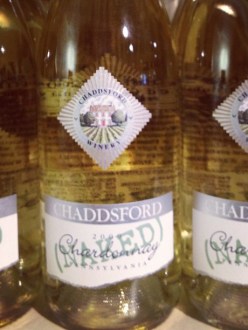
My friend Josh demonstrated “the slosh” by swirling the wine around the glass. He looked very classy and nonchalant while doing this. Then we tasted our choices using words like bouquet and smokey. The truth is, for all of our jokes, we really did mean what we said when tasting the wines. They WERE smokey or bright with balanced acidity. Chaddsford Winery makes good wine. I recommend the ’07 Merlot and ’09 Pinot Noir. I’m a red girl, so most of my choices were red. However, I enjoyed their Naked Chardonnay (no oak makes it naked), a steal at only $15.99 a bottle. So light and refreshing! Perfect for a summer dinner al fresco.

Chardonnay, disrobed

After the dry wines were tasted, it was time for dessert. Upstairs we went to taste the sweet wines. I’m not a fan of sweet wines, but I cannot turn down free wine in any form (see, the husband and I belong together). Overall, the sweet wines were just that. . .sweet. The Niagra, an award winner many times over, tasted like white grape juice with a little kick. The Sangri-la Sangria was cloyingly sweet with a watermelon Jolly Rancher finish. Not my favorite. The sweet wines found redemption in the Spiced Apple Wine. It was laced with cinnamon and tasted like hayrides, apple orchards, and pumpkin patches. This is the sweet wine to keep around during the holidays. I’m going to buy a bunch for Christmas gifts.

After tasting all that excellent wine, we took a walk around the grounds. The winery is lovely, complete with outside patio where you can enjoy a bottle and snacks from the winery store, like local cheese.

Cheese from Elverson, PA

Very serious wine tasters

Perfect day for a wine picnic

Out front is a cute little vineyard. Each row marked with signs noting the kind of grape grown. Chaddsford Winery has had their own vineyards in the past, but currently buys their grapes from local growers.

Trial vineyard

Zinfandel

Not too far from the vineyard is the sweetest arbor. The bench beneath it cried out for a photo shoot.

Photo shoot waiting to happen

Photo shoot accomplished

After some gratuitous photo taking we decided to head to an early dinner.

In keeping with the wine as poetry theme, I leave you with my very own haiku to the Chaddsford Winery (inspired by this guy).

Four friends and good wine

Balanced, brilliant and sweet

Thank you, winery

Pretty arbor with a view

Chaddsford Winery

632 Baltimore Pike

Chadds Ford, PA 19317

About these ads
Categories: Local Stores, Wineries | Tags: , , , , , , | 3 Comments

BJ’s Goes Local

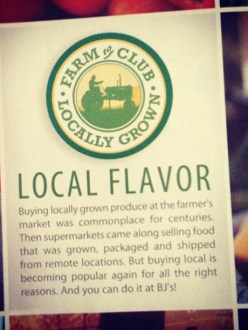
My mother loves stores like BJ’s Wholesale Club and Costco. She will come home with giant containers of olive oil and enough ketchup to last a thousand summer barbecues. The produce she buys there is always so pristine and BIG. Enormous apples, large cellophane packages of bright red peppers, and oranges as big as my face. I can’t help but think this is unnatural. The produce is too glossy, too perfect. So when my brother told me BJ’s will offer members a “Farm to Club” program, I didn’t think much of it. (We’re talking about a store that sells TVs, furniture, mouthwash, salmon and baby wipes all at once. I don’t think “local” when I think BJ’s.) Then I saw this in a copy of BJ’s Member Journal I inexplicably received in the mail:

Farm to Club Logo

Apparently, the local trend is catching on! BJ’s defines local as “grown within the state.” So that means in June, bins and crates marked with the Farm to Club logo will offer shoppers Delaware produce such as zucchini, tomatoes, corn, green peppers, yellow squash, and cucumbers.

I know my mom will never give up her BJ’s membership and the ability to buy ginormous vats of butter and spaghetti sauce tri-packs. But now I can rest easy because come June, she can add local produce to her over-sized shopping cart. Thanks, BJ’s!

Categories: Delaware Farms, Local Farms, Local Stores | Tags: , , , , , | 4 Comments

Pink Slime, Coasters and Personal Responsibility

While ordering coasters from my friend Julie’s Etsy shop, Maida Some Art, I discovered Etsy’s blog. I’m always up for reading a blog, so I perused the topics.

These are the coasters I ordered, and they make me happy every tiime I set my glass down.

Lo and behold, I found a post by Danielle Tsi called “How Pink Slime Can Make You a Better Eater.” My interest was piqued, of course, as pink slime is a topic that spurs me on to become a social activist, complete with picket sign and slogan. Danielle’s take on the whole thing is very close to my own. Change begins on an individual level, by interacting with food in a different (and purposeful) way. For me, being more purposeful with food means sourcing my food from local growers and farmers. I know where the spinach for my next salad comes from if it’s grown in John’s backyard. And you know what? It tastes better that way.

Be an advocate for change with every bite you take. As Danielle says, stopping pink slime in our food supply can be as simple as “Know[ing] the difference between an apple flown across thousands of miles and a fresh one harvested at its peak of ripeness.”

Read on for more of Danielle’s thoughts.

No one likes reading bad news about our food. From high-fructose corn syrup to genetically-modified ingredients and food safety recalls, each time a health scare makes the news the repercussions linger. We tweet, Facebook and blog, writing passionate status updates about how important it is that something, anything, be done. We start online petitions. Each tweet and hashtag fuels the fire of mass online disgust that lasts for about a week before the news cycle renews itself and all is forgotten. Until the next scare.

The recent uproar over “pink slime” in hamburgers and school lunches followed the same pattern. As Andy Bellatti put it, it’s a case of “same script, different cast.” For those unfamiliar with the issue, “pink slime” is a term coined in 2002 by former USDA microbiologist Gerald Zirnstein to describe a product developed by South Dakota-based Beef Products Inc. Its owner, Eldon Roth, developed a process that turns slaughterhouse scraps – the excess fat closest to the skin of a cow, and from other cuts of meat – into a lean beef filler free of E. coli and salmonella that burger makers could mix into patties. Those annoying pathogens would be taken care of once batches of Lean Finely Textured Beef (its official name) went through a bath of ammonia gas, which, we are assured, is actually food safe (it isn’t the same type of ammonia found in household cleaners). Not only did we discover last month that this ingredient is present in 70 percent of raw ground beef sold in America’s grocery stores, the public learnt of the USDA’s plans to buy seven million pounds of the product for the National School Lunch Program.

It is tempting to throw one’s hands up in despair; I did, when I read the news. I don’t even have kids, so I can only imagine the anxiety that parents of school-age children must feel.

See the rest of Danielle’s article here. Or read Danielle’s blog Beyond the Plate; it’s filled with insightful food thoughts and studded with her beautiful photography.

Oh, and while you’re at it, visit Julie’s shop on Etsy. She is a talented, full-time artist who loves imported olives, but also gets her eggs from the farmer down the street.

I own this stunning print.

Categories: Delaware Farms, Farmer's Markets, Local Farms | Tags: , , , , , , | 2 Comments

A Local Eggplant Conundrum

I bought an eggplant. It was local, of course. Because it was the only local item at the farmer’s market, I snatched it up, cradled it like a baby for a few seconds, and proudly put it in my shopping cart. This was before I remembered that I’m not a fan of eggplant (that “local” sign gets me every time). I’ve had it before. Breaded and fried in the ubiquitous Eggplant Parm. Or hidden in a veggie Panini. Each time I’ve been unimpressed.

I vowed that my local eggplant was going to be an excellent addition to dinner, so I did what anyone who doesn’t know what to do with eggplant does to eggplant: I grilled it. Cut it in slices and put it over fire with some other veggies and chicken thighs (yum). Grilled eggplant turns out to be pretty tasty, especially when doused with kosher salt, fresh cracked pepper, and olive oil.

Herein lies the conundrum: leftovers. What does one do with half of a grilled eggplant? After checking the fridge to see what other ingredients I could use, I turned to my life coach and main problem solver: google. After searching for eggplant, portobello, and pasta, I was rewarded with a recipe from Serious Eats, a food blog. Conundrum solved. Thank you once again, google!

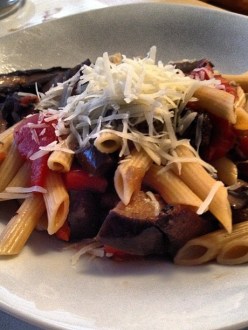
Miraculously, I pulled together this pasta easily with what was already in my larder (larder is an amazing word). I adapted the recipe a bit, so here’s my version:

Ingredients:

1 medium eggplant, cut into large cubes (mine was already cooked so I just cubed it up)

1 pound pasta (I used penne, but the original recipe recommends rotini, and I concur. It would have been better with rotini!)

Kosher salt

2 tablespoons extra-virgin olive oil

2 tablespoons unsalted butter

3/4 pound portobello mushroom caps, cleaned and cut into 1/4 inch slices

2 generous pinches red pepper flakes

2 medium cloves garlic, minced

2 teaspoons fresh thyme leaves

Juice from one lemon

1 (28-ounce) can diced tomatoes, mostly drained

Freshly ground black pepper

Parmigiano-Reggiano

[This is where Serious Eats gives a nifty way to cook eggplant, using the microwave to pre-cook. Mine was already grilled, so I skipped this step. Check out this link to see their method.]

Cook pasta according to al dente instructions on box. Make sure to salt the water liberally. Drain pasta, reserving 2 cups of the cooking liquid.

While pasta cooks, heat olive oil and butter in large skillet over high heat until melted and beginning to brown. Add the mushrooms. Cook until the mushrooms begin to brown (about five minutes). Add the red pepper flakes. Toss in the eggplant to warm through. Add garlic and thyme, stirring constantly, about 30 seconds. Add lemon juice and tomatoes. Bring to a simmer and season to taste with salt and black pepper.

Add cooked pasta to sauce, adding extra cooking liquid until sauce reaches desired consistency. (The sauce will not be thick, but it will be yummy.) Serve with a generous portion of grated Parmigiano-Reggiano.

This recipe was fresh, lemony, and bright. I will make it again, but next time I’ll add more red pepper flakes!

Delicious Conundrum

Categories: Farmer's Markets, Recipes, Summer Recipes | Tags: , , , , , , , | 10 Comments

Local Flavor at Home Grown Cafe

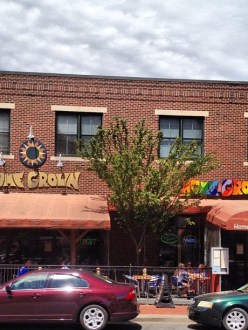
When I was younger, I referred to Home Grown Cafe  as “that hippie place” on Main Street. Now well into my adult years, I view Home Grown Cafe as more hipster than hippie. Home Grown does things on its own terms. It is culturally aware and upholds certain food values. Vegan options abound on the menu and local bands play often.  I can’t label Home Grown as completely hipster, because the owners obviously care about the food and the restaurant environment. (Hipsters, on the other hand, are supposed to NOT care, or at least act like it. Isn’t that why they let their facial hair grow, wear old t-shirts, and drink Blue Ribbon?)

When you walk inside Home Grown Cafe, the vibe is slick, well-planned, and mellow. I could bring my parents here for lunch and also enjoy a beer (even local beer like Dogfish Head and Yards!) with friends while listening to a band on a Saturday night. On this particular day I was with my husband. We sat outside to enjoy the gorgeous Spring sunshine.

Plenty of outdoor seating

I’ve been here before, but I never really took the time to study the menu. Like I said, most dishes can be prepared vegan. Or if you prefer a steak, you can get that too. The menu has a lot to offer, from Crab Fondue (served with green apples and warm bread. Bomb.) to a Southwestern Burger (or Veggie Burger!). My husband ordered the Falafel. It is garlicky and fresh; I love the bean sprouts!

Yummy, yummy falafel

I ordered the green apple salad with grilled chicken. I could have ordered my salad with salmon, hangar steak, tofu, grilled shrimp, or a number of other proteins. The real star of this salad was the apple vinaigrette. Perfectly balanced and tangy.

Before

After

I talked to manager, Elizabeth, for the local scoop. Elizabeth says that the menu specials change based on the seasons and what’s available locally. During the growing season, the restaurant’s produce is sourced from Lancaster Farm Fresh Cooperative. Lucky for us, Home Grown is also a pick-up location for the Lancaster Farm Fresh CSA. Every Monday from May until October, if you are a member of the CSA, you can pick up your produce, fruit, or medicinal herbs, at the restaurant. Elizabeth says there’s a swap box available for members that want to trade something out (last year everyone traded dandilion greens. A lot of dandilion greens.). In addition to the local produce, Home Grown also sources mushrooms from the Kennett area and goat cheese from a local farm. Local farmer’s markets, like the Newark Farmer’s Market, are used whenever possible.

A restaurant with a cool hipster vibe that cares about local food, local arts, and the local community? I’ll be back! Home Grown Cafe definitely has a local flavor all its own.

Home Grown Cafe's menu logo. Local flavor indeed.

Home Grown Cafe

126 E. Main Street

Newark, DE 19711

302.266.6993

Categories: Local Farms, Restaurant | Tags: , , , , , , | 12 Comments

How to Plant Local Corn

Last Friday I was pleased to hear John on my voice mail. Was I interested in helping him plant the last of the corn? Does he even have to ask? I was thrilled to help! I rushed home to change into appropriate farmer gear. (No, not overalls, but I’m considering purchasing a pair. Too bad I didn’t keep my “grunge” ones from the 90s. I was so cool.) After grabbing my compost bucket, I headed to John’s house. Yes, you read that right. I now have a compost bucket. I throw all of my food waste into said bucket, things like egg shells and carrot peels, and bring it to John’s house for his compost pile. I feel like I’m part of the circle of life or something!

After emptying the bucket into the compost pile, John and I took a look at the blue bird house. Two birds, male and female, have been in residence because inside was a beautifully- made nest with two perfectly dainty pale blue eggs side by side. John loves when the blue birds are around. He knows their song.

Lovely little nest

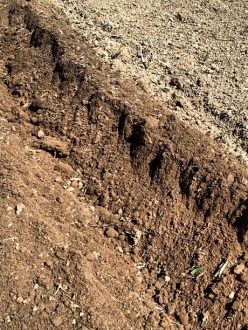
We planted the corn not too far from the nest’s cozy home. First, John made a furrow.

Neat and tidy furrow for corn

I thought we would plant the seeds now, but not so fast. In went some soybean meal to add nitrogen to the soil.

Soybean meal, a natural fertilizer for nitrogen loving plants, like corn

Scattering soybean meal in the corn furrow

So now it’s time for the seeds, right? Not quite yet. We all know that John is proud of his compost. He should be!  He works hard for it. I filled the furrow completely with compost.

Compost in

Now it’s time for seeds! Well almost. . .Before the seeds went in, John showed me how to spread the dirt from one side of the furrow over the compost, using a rake.

Compost cover-up

With that done, NOW it’s time for seeds! Silver King seeds to be exact. I placed the seeds about eight inches apart. Unfortunately the pictures of the seeds I took were lost in translation; I think the sun was too bright.  Just imagine large corn kernels nestled on top of dirt. With the seeds sown, I carefully raked the rest of the dirt over the seeds and tamped down a bit.

Covering the seeds with a blanket made of dirt

And now we water and wait. It’ll be exciting to see a six-feet tall corn stalk standing in the row I planted. Come to think of it, in the fall my mom buys corn stalks from John to decorate her mailbox. I wonder if she’ll buy one of the stalks I planted?

I’m telling you, there’s nothing more relaxing than working in the garden on a glorious Spring day, especially with John for a teacher and blue birds to keep you company.

Categories: Delaware Farms, Farmer's Markets, Gardening | Tags: , , , , , | 7 Comments

Ranch Hand Chickens and Other Definitions

In general conversation as of late, I’ve been throwing around food terms, assuming others are on my page. The most common question is,“What’s a CSA?” I’m happy to explain (with gusto) that a CSA is the best thing ever.

Wondering if there are other food terms I use that people have never heard of, I decided to try an experiment using the husband as my test subject. You’d think he would know all about these particular terms, since they are near and dear to my heart. Even so, I asked him to define a bunch of food-related words, which he did in fine form. Some of the terms he knew, some of them he answered with a question, and some of them he just didn’t know at all (much to my surprise). Here are the results for your reading enjoyment (I’ve put my definition and random comments in italics next to his definition).

LOCAL: Food that doesn’t have a commute. Nicely said, Husband. I define local food as food grown in your community or very near your community. I also like to think that local means you know the person growing your food; you and the farmer are part of the same community.

LOCAVORE: Someone that eats only what’s in his own house. Very funny. Maybe he thinks this way because I gladly do all the food shopping and it magically appears in the cupboard. A locavore is a person choosing to eat only local foods, preferably raised or grown within a 100-mile radius of his or her own house. Most locavores I know choose organic and sustainable farming methods as well.

ORGANIC: Of the earth. That’s a nice way to think of it. More specifically, organic as it pertains to food means no chemicals, additive, pesticides are used in any stage of production.

PASTURE FED: Getting a regular dose of God’s Word. Oh, I thought you said PASTOR-fed. That’s more amusing when you realize the husband is actually an ordained minister who preached a sermon in church this morning. Pasture fed just means that the animals (chickens, pigs, cows) have free reign of a pasture in order to eat grass, bugs, etc. This is a sustainable form of agriculture because the cows eat the grass, then fertilize the grass; more grass grows, and cows eat the grass. It’s like the circle of life.

GRASS FED: Isn’t that when cows are vegetarians? ALL cows are vegeterians even when fed grain to fatten them up. My definition for pasture fed fits the bill here, too.

GMO: Food made bigger and better by chemicals. He’s been paying attention! I’m so proud. Maybe it’s because I compare GMOs to the Teenage Mutant Ninja Turtles, his favorite childhood cartoon. GMO stands for Genetically Modified Organism. This means that the genes of the food have been altered to heighten certain characteristics (like creating food to withstand pesticides). GMOs are banned completely in Europe due to health concerns, but the United States offers countless GMO products. For a list of GMOs, click here.

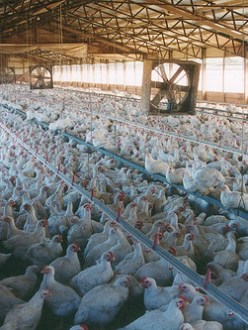
FACTORY FARM: A factory that makes a lot of farms, assembly-line style. Nice try. Factory farming is industrialized farming. Livestock or chickens are raised in dark confinement (in cages or barren plots), too close together, making them suseptible to disease. As a result, the animals are fed a steady diet of antibiotics. This is why grass-fed is better. Better for the animal and better for you.

FREE RANGE: When chickens don’t live in coups, and they help out on the farm, kind of like ranch hands. Yeah, chicken ranch hands, free on the range. I’m picturing chickens in tiny vests, riding goats, and lassoing bugs. As nice as that sounds, free range means the animals are able to roam freely and are not confined to cages or overcrowded pens. This method of farming is unregulated and oftentimes, when you see an egg carton or a meat package touting “free range” it means nothing. Perhaps the chicken coup has an open door, but it doesn’t mean the chickens are able to get outside. This is just one reason it’s important to know the farmer raising your meat and another reason to buy local.

Sad chickens Photo credit: earthsongfarm.com

Happy Ranch Hand Chickens Photo credit: cranburybrookfarm.com

HORMONE-FREE: Me in the fifth grade. I knew the husband in fifth grade and he’s right. Hormone free means no hormones are added to an animal’s feed to make it grow bigger and fatter in a shorter period of time. Most milk is tainted with hormones as dairy cows are often injected with rBGH.

FARM TO TABLE: No middle men. Nice definition. Farm to table refers to a growing food movement in which food is locally grown and sold directly to you by the farmer. A farmer’s market is a nice example, or a farm to table restaurant. The restaurant buys from the grower, not from a corporation like Cysco.

COMMUNITY SUPPORTED AGRICULTURE: When a neighborhood has a garden. That’s a very nice sentiment and wouldn’t it be lovely if every neighborhood shared a garden? The official definition as seen on localharvest.org is as follows: a farmer offers a certain number of “shares” to the public. Typically, the share consists of a box of vegetables, but other farm products may be included. Interested consumers purchase a share (aka a “membership” or a “subscription”) and in return receive a box (bag, basket) of seasonal produce each week throughout the farming season.

CSA: Pay a sum up front in exchange for produce throughout the growing season. So the husband knows the initials for Community Supported Agriculture. Well done! The definition is the same as above.

IN SEASON: Food that’s naturally ripe right now. That’s correct! In season refers to the time of year a food is at its peak of flavor, like asparagus in spring or tomatoes in summer.

ALL NATURAL: No chemicals used. Unfortunately, all natural SHOULD mean no chemicals or additives, but I think the term is useless. Anyone can put “all natural” on a food label and it doesn’t mean a thing. Look for Certified Organic or USDA Organic.

PROCESSED: I’m assuming that happens in a factory and makes food easier to eat. I believe he meant more convenient to eat, and that’s true. How convenient is a double cheeseburger at McDonald’s? Way too convenient, in my opinion. Processed food can be any raw food that is altered from its original form, but I consider processed food to mean any food that is altered excessively, packaged attractively, and marketed to the consumer. Kind of like a Pop Tart.

SLOW FOOD: When the pizza guy takes like 45 minutes. Haha. Actually, slow food is just the opposite of processed food. Making sure food stays in its original form, without processing, chemicals, additives, or engineering of any kind, is what the slow food movement is all about. It’s a new way of thinking about food; a way to counteract our current fast food culture.

So what did I learn on this food term experiment? A few things. . .

1.) Maybe the husband’s “listening mannerisms” are the same as his “glazing over mannerisms”.

2.) Food terms can be confusing and overwhelming, even for some one surrounded by them on an almost daily basis (I watch an excessive amount of food documentaries and I like to talk about them to the husband. He is a patient man).

3.) The terms don’t really matter that much, as long as we know where our food comes from and have healthy, local choices available. For example, the husband has not bought a bag of barbecue potato chips since February. That’s progress!

Categories: Farmer's Markets, Gardening, Random | Tags: , , , , , , , , | 4 Comments

Phew! I Am Not a Gardening Failure

The other morning I walked tentatively to the garden bed to find an excellent surprise: the garden is growing! I’m not sure why I’m so surprised by this “phenomenon.” Don’t gardens grow? Isn’t that what they do? Wasn’t that the purpose of sowing seeds and watering incessantly?

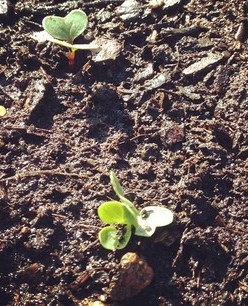
All true, but I am still heaving a sigh filled with relief and anticipation. So far, here’s what my labor produced:

Sprouting radishes. I'm so proud.

Micro-arugula

The arugula is coming along nicely, but I do believe the little sprouts are too close together. This could be because the ever-helpful husband kind of just dumped the entire seed packet into the row. So we will either have lots and lots of arugula (which is fine by me. It’s my favorite.) or the little guys will choke each other out in a battle for survival. I’ll probably thin out the bed before that happens, though. (Look at me talking intelligently about gardening!)

I see a slight bit of growth on the spinach side of the bed, and the beets are just peeking out. We are expected to have weather in the mid-80s tomorrow, so I’m hoping my darling veggies will respond.

Enjoy your weekend! I’m off to water MY garden.

Categories: Gardening | Tags: , , , , , , | 5 Comments

Parsnip Accolades

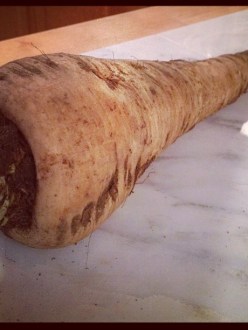
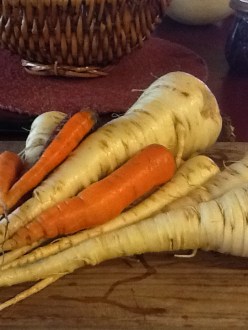
I’ve been talking about parsnips a lot lately. Mainly because my friend Valerie gave me one from her garden, and also because they are delicious when smashed with sweet potatoes and topped with goat cheese. One particular parsnip, Valerie’s miracle parsnip, has brought me joy of another kind. Because of my review of said parsnip, Valerie’s husband Rogers included me as an example of “pretty good writing” on his blog, The Writing Rag. This blog shares tips on how to write well and satisfies the grammar nerd in me.

The parsnip in question

I am honored and amused by this accolade. Honored because Rogers said my grammar was nearly perfect; except for a missing comma and one tense he would have changed. Amused because tenses are the bane of my existence (that’s dramatic, but you get the idea). There are times I change an entire post’s tense, only to change it back (I just changed the tense of this sentence, in fact). Passive verb tenses get me every time. That’s why I’ll be studying up on them via The Writing Rag.

Another exciting accolade I received recently (I sound so “braggy”) was in the form of a fresh-baked loaf of bread and a jar of hot peach jam from Rumbleway Farm. Yes, you read that right. Hot. Peach. Jam. As in sweet peach jam with the warm, smooth heat of jalapeno. (And that, my friends, was a fragment. I do that sometimes. For effect. See? Sorry, Rogers!) My friend, Anita, gave me these gifts after hearing of my love for Rumbleway Farm. She attached a note that included the words, “P.S. I love your blog!” Yummy, yummy accolades. Thank you, Anita!

Hot. Peach. Jam.

The last accolade might not be an accolade at all, but it is exciting nonetheless. My friend, Beth, lives in Massachusetts (my former stomping ground). She’s a fan of my blog, and we’ve been conversing on Facebook regarding food, recipes, and gardening. As a result of reading my post, The Amish Know Best, Beth went to localharvest.org and found a CSA near her. Now, she and her three beautiful daughters will enjoy visiting Billingsgate Farm every Saturday to pick what goes into their CSA box. When Beth posted her plans for a summer CSA, I was thrilled beyond words. The fact that I had something to do with a family supporting a farm and, in turn, eating organic, affordable, and LOCAL produce is an accolade I will relish. It’s the whole point of Rachel’s Table!

One more accolade in which I will bask: Mr. Writing Rag called my posts “useful.” Like I said, that’s the whole point of Rachel’s Table. I’m so pleased. Thank you, Parsnip.

Categories: Gardening, Local Farms | Tags: , , , , , , , | 6 Comments

A Letter to My Inner Foodie on the Subject of Becoming a Locavore

Dear Inner Foodie,

I hate to break it to you, but you have been beguiled by the slow food movement, and you are in for a rude awakening.

Eating locally and being a “foodie” are not the same thing. At all. While the definition of foodie is varied, I like this one best: having a love of food for consumption, preparation, and study (thank you, Wikipedia). Unfortunately for you, the definition of a locavore is not as broad: a person who endeavors to eat only locally produced food (thank you, New Oxford American Dictionary).

Do you see what I’m getting at here? You are selling your foodie soul to an unattainable cause. Eating locally produced food means there are limits to what you can consume and prepare. As a rule of thumb, that limit is a 100-mile radius of your front door. Not to burst your bubble or anything, but do you have a garbanzo bean patch in your backyard? Do you know someone who does? I didn’t think so. No hummus for you. Have you seen an olive tree in Delaware?  No? That means your favorite citrus-marinated olives will stay with all the other deliciously tempting olives in Whole Foods’ olive heaven section.  Did you mistake Delaware for Florida? Then why do you drink orange juice with your scrambled eggs in the morning? Perhaps you think this is California, because I see five avocados on your kitchen counter.

Do I really need to go on?

As a foodie, the world is at your culinary fingertips, but as a locavore, you’re stuck with whatever grows in the confines of the Mid-Atlantic States. Frightening when I think about how much you love sushi.

Do you see what you’re giving up? You’re giving up nutella, cucumbers in the dead of winter, parmigiano-regianno,  peanut butter, Italian wine, and out of season tomatoes…you’re giving up tomatoes that were genetically engineered to survive a 1,500 mile tractor trailer ride unscathed so that you can choose a perfectly round one for your obligatory dinner salad. And why would you give that up? For a similar tomato grown with love, care, and sunshine in the organic soil of John’s backyard and sold to you the same day it was picked?

Oh.

I get it now. I put all sarcasm and forewarnings aside for that one glorious summer tomato.  Quell your fears, Inner Foodie!  I assure you it will be worth it.

Much (local) food love,

Rachel

Categories: Delaware Farms, Random | Tags: , , , , , | 8 Comments

Blog at WordPress.com. Theme: Adventure Journal by Contexture International.

Follow

Get every new post delivered to your Inbox.

Join 1,398 other followers

%d bloggers like this: